Tuesday, January 22, 2013

The Flag of Childhood

"The Flag of Childhood: poems from the Middle East,” compiled by anthologist Naomi Shihab Nye in 2002, is an anthology of about sixty poems written by authors from the Middle East. The poems are written by poets from varying Middle Eastern regions such as Jerusalem, Palestine, and Israel. Each poem varies in length from just a few lines to maybe about two pages, which can accommodate a variety of activities in the classroom. As a whole, there are a few themes that arise often are 
nature, longing for a home, and family ties. While each of these themes is somehow made significant to the region, these themes are not only specific to the Middle Eastern region, but also can be applied to students from other cultures. Therefore, there are quite a few teaching moments to be had in terms of connecting students to cultures other than their own. The wide variety of poems allows teachers to pick and choose which topics they think would be most relatable to their students needs. The only aspect of the anthology that I did not find appealing was some of the translations of the poems. It seemed that there were a few poems that it was noticeable that some sort of meaning was lost in the translation to English. I also found that some supplementary materials might also be useful to explain the context for which the poems were written. The poems give an interesting insight into life in the Middle East that could certainly be expanded with supplementary material. That said, I do not think an entire study on all of the poems would be effective in a classroom, but certainly excerpting the most relevant poems would be useful. This anthology certainly has teachable poems and could definitely be used in a classroom to introduce middle school students to the Middle Eastern culture in an interesting way.  

"Jesse" by Gary Soto


Gary Soto’s 1994 novel Jesse deals with two latino brothers, Jesse and Abel, as they take jobs picking in fields in order to support themselves through college and to get themselves on a road out of poverty. At the onset of the story, Jesse lives with his mother and drunken stepfather. At the age of 17, Jesse moves in with Abel and the two work to pay for rent and cheap food. Throughout the story, Jesse attempts to reconcile his current social situation with the grand dreams he has of becoming an artist.

Jesse is largely a coming-of-age story, as it focuses on Jesse’s experiences with dating, family relationships, schoolwork, racial issues, and growing independence. The coming-of-age story in the novel is paralleled by the striving of Mexican Americans to achieve social equality. Jesse attends a couple Mexican American rallies, and the growing independence and worldliness of Jesse is mirrored by the growing power and momentum of the Chicano movement of the early 1970s.

Jesse is written in a very straightforward style, and should not be a difficult read for students ninth grade and up. The book does contain a few scenes involving violence and mild sexual content, but these scenes are relevant with the themes of maturation and coming-of-age, and many of the thoughts and emotions of the narrator during the heavier scenes of the book can be easily relatable for high school students. Jesse could be useful in teaching metaphor, Mexican American social struggles of the 1970s, and coming-of-age issues during adolescence. The book does place a heavy emphasis on religion, particularly Christianity, which could prove an issue when teaching in a culturally diverse classroom.

Hoops by Walter Dean Myers


Hoops by Walter Dean Myers

This novel entails the classic storyline of a talented young adult, Lonnie Jackson, and his struggle to cope with life in the Harlem ghetto.  After his dad had left him as a young child, Lonnie spends his childhood battling any character with trust issues.  Even with dealing with a broken home and a terrible part-time job, Lonnie's basketball talents are still prevalent.  After meeting up with his peers at the gym, the crew decides to submit themselves into "The Tournament of Champions" basketball tournament, where they are going to be coached by a local drunk, Cal, who turns out to be a former basketball player, until his gambling and alcoholism caught up to him.  Once realizing Lonnie's potential, Cal constantly pushes Lonnie to reach for greatness, but Lonnie's trust issues and attitude leads to turmoil between the star and coach, to the extent where a gun enters the scene.  It is also revealed that Cal is still tangled in the gambling game, and Lonnie's team has entered the laundry list of poor decisions made by Cal.  Cal now has to decide between sitting Lonnie in the tournament to win a huge bet, or to face the music in order to save Lonnie's future.

This book is a great motivational piece that portrays the hard-knock life of Harlem, New York and the culture.  Walter Dean Myers creates characters that can connect with several readers who may struggle with divorced parents, lower class socioeconomic status, or the risk of exposing one's own weaknesses to achieve full potential.  This book was a quick, meaningful, read that serves as a piece of cultural identity for the urban community and youth alike.

Learning to Swim by Ann Turner


Learning to Swim

Through a series of short, free verse poems, Ann Turner tells a dark and painful story of her traumatic summer spent with her family, friends, and an abusive older boy that lives near her summer vacation house. Written from the first person perspective, the reader is forced to imagine some of the horrific experiences that were encountered by a naïve, innocent little girl. Turner captures not only the pain and confusion endured during her youth but also the emotional turmoil that has haunted her since that dreadful summer. 

This book has some brief moments of graphic violence and sexual abuse, making it hard to digest at times, but the overall message is extremely uplifting and optimistic. Turner writes: “These poems are a testimony to the healing power of words”. Her book aims to inspire her readers with hope, courage, and strength so that they might be able to find ways of coping with their own problems, rendering this book an appropriate read for only mature students of the middle school age or higher.

The collection of poems reads quickly and easily but it is not without a variety of useful literary devices. Turner exemplifies descriptive writing with this work and displays her skilled use of similes, metaphors, personification, and imagery proving this text’s worth in a secondary level classroom. 

The Buddha Book by Abraham Rodriguez

                                               
 The Buddha Book, Abraham Rodriguez, Picador USA, 2001

The Buddha Book tells the story of Puerto Rican teenagers in the South Bronx. Two best friends, Jose and Dinky, are making a mark in their high school by anonymously writing "The Buddha Book," a comic that tells the hidden secrets of the school. The story starts with Jose murdering his ex girlfriend, Lucy. Jose is obsessed with this act, writing about in his comic and seeing her ghost around. Jose plans on using the comic to not only turn himself in, but make a name for himself as well. Dinky is trying to separate himself from the history his drug dealer father gave him. He is doing his part by bringing his family back together again. He also gets involved in a romantic relationship with Anita, which also goes into "The Buddha Book." Anita is Jose's half sister who is trying to make herself famous by becoming the most notorious female serial killer of all time.

This book explores the idea of forming your own identity. All of the main characters in this book are doing their best to make a life of their own, outside of what is expected of them, whether it be good or bad. Throughout the novel, Jose and Dinky find a release through comics. Rodriguez explores how the arts help people and allow these boys to find out who they are. Jose, Dinky, and Anita all have struggles in family life as well. This focus on comics has a lot of options for creative assignments for the teacher to assign. They each need something to separate themselves from their parents and the expectations the parents have for them.  This novel spends most of its time with the males, using a third person objective narrator, primarily focusing on Jose's point of view. Male students might appreciate a voice similar to their own. 

Although this novel does a good exploration of self identity , I would not recommend it for a middle school classroom for a variety of reasons. First of all, as all of the characters are Puerto Rican, there are many times where the characters would speak Spanish for paragraphs at a time. As someone who has never studied Spanish, it isolated me from the text and I could no longer know what was happening. This could easily happen for almost all students involved. Second, there is a lot of foul language in the book, with harsh swear words occurring on almost every other page. Third, there were a few very explicit sexual scenes in the book. I felt uncomfortable reading them. Along with that, many of the females were portrayed in a hyper sexual manner; constantly wanting sex and at one point starting an orgy. There were many ideas that were so sexual I couldn't imagine a teacher trying to explain it to a classroom. Finally, it  should not be taught because of the focus on murders. Neither Jose or Anita seem to feel any pity for those around them. Anita goes out and looks for men to sleep with and then murder. If a teacher wanted to teach this, I feel many parents would complain and the book would get banned. If it were to ever be used in any type of classroom setting, I would say an upper high school's independent reading. I don't think anything lower than 11th grade can handle the mature quality of the text. 

Monday, January 21, 2013

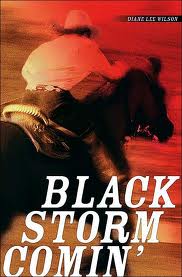
Black Storm Comin'

Black Storm Comin’, Diane Lee Wilson, Margaret K. McElderry Books, 2006

              Black Storm Comin’ is about a 12-year-old boy of mixed race, Colton Wescott.  It is 1860 and he is travelling with his family along the Pony Express Trail from St. Joseph, Missouri to Sacramento, California.  Colton’s Dad has just deserted the wagon train.  The family continues on.  The baby brother dies and the mother becomes very ill.  They stop in a little town in present day Nevada on the east side of the Sierra Nevada Mountains.  Colton struggles with the problems of losing the oxen, paying for the doctor, caring for his sisters, and trying to deliver freedom papers to his mother’s sister in Sacramento.  He decides to work for the Pony Express to make money and get to Sacramento.
                This book is definitely a good choice for middle school students and it’s a fun read.  Colton is the same age as the students allowing them to connect with the character.  Because his father left, he struggles with taking over as the man of the family and sometimes he just wants to be a kid.  He has an African-American mother and a white father so issues of race come up especially since the Civil War is practically upon them (I thought the book did a superb job with this issue).  Since the book takes place in 1860 there is the added benefit of a little bit of history and geography.  Finally, it deals with family issues, responsibility, and is an all-around coming of age story.  Since the book does such a fantastic job of dealing with several issues it makes approaching the issues easier.  The text is on the longer side but it kept a good pace and wasn't difficult to follow.  Overall, I would definitely recommend this book.

A Hero Ain't Nothin' but a Sandwich

A Hero Ain’t Nothin’ but a Sandwich, Alice Childress, Avon Books, 1982.

This story is written through narrations from the perspective of the different characters in the life of Beniie, a 13-year-old black boy who shoots heroin.  Benjie doesn’t believe that he has an addiction, but the pain he causes the other characters through his drug use is obvious in their narrations.  His best friend is a good student, and although he gave Benjie his first joint, he shies away from drugs and focuses on his schoolwork.  According to his teachers, Bernard Cohen and Nigeria Greene, he was a great kid before he started doing heroin.  This story follows Benjie’s struggles with drug use and the pain that it causes his family and friends.  He fights his relationship with his caring stepfather and family and distances himself from those who truly care about him, but it isn’t until he is turned in that he must truly decide whether he wants his family or his addiction. 

This story has many themes that are teachable in a middle school setting.  The dichotomy between the black and white teachers in Benjie’s school highlight differing racial relations and viewpoints in society.  Through the individual narrations, the reader can see the thoughts of the two characters and can see both sides of the discussion.  The struggle with Benjie’s drug addiction can also be discussed, as well as Benjie’s family relationships.  Consequences of his drug use such as distancing from friends and family are evident in the story.  His success in school also begins to decline, which only serves to further his family troubles.  Overall, despite the interesting themes and exciting plot line, I would be weary teaching this story.  Although this book has many teachable themes, there was some foul language and heavy moments that may be inappropriate to middle school students.  The dialect that the book is written in might also be slightly difficult for students to understand, although it could be easily explained if read in class.  I think that this book would be teachable to older students in the middle school; it would definitely be more appropriate for eighth graders rather than sixth graders.  It is a short book and can be read rather quickly.  The themes are rather heavy and there is a decent amount of language in this book, but it could be teachable if handled carefully.